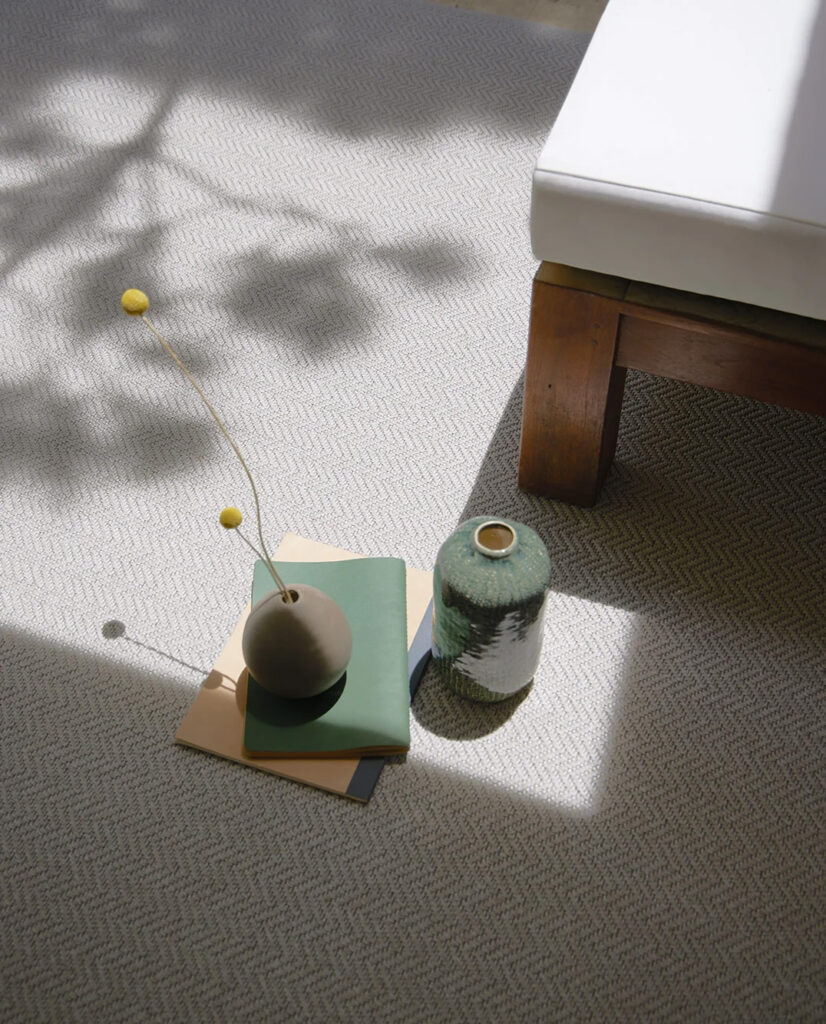
When selecting carpets for commercial spaces, the most important factors are matching the material, durability, and visual appearance to the actual purpose of the space. Offices, restaurants, and hotels have very different requirements than private homes: fire safety, ease of maintenance, and resistance to heavy use take priority. This checklist covers the key questions every designer should consider before choosing a carpet.
What requirements must carpets for commercial spaces meet?
Carpets for commercial spaces must meet significantly stricter requirements than those intended for residential use. The most important criteria are fire safety, durability, ease of maintenance, and indoor air quality. Many projects also require the M1 emission classification for building materials, which confirms that the product does not release harmful substances into the indoor air.
- Fire safety: In commercial spaces, carpets must meet fire classification requirements. This should be verified on a product-by-product basis before purchase.
- Durability: In high-traffic areas, the carpet must withstand repeated use over many years without deteriorating quickly.
- Ease of maintenance: Cleaning must be efficient and quick to keep the space tidy in everyday use.
- M1 emission classification: Many products in our range carry this certification, which supports a healthy indoor environment.
- Acoustics: Textile carpet effectively absorbs sound, improving the comfort and ambiance of the space.
The choice of material directly affects how well a carpet meets these requirements. Polyamide is a common choice for high-traffic areas, as it is highly durable and easy to keep clean. Wool, on the other hand, offers natural fire resistance and a premium feel. We carry a wide range of products suitable for commercial spaces in all of these materials.
How does the purpose of a space affect carpet selection?
The intended use of a space largely determines what type of textile carpet for commercial use is most appropriate. In restaurants, liquid resistance and easy cleaning are paramount; in offices, acoustics and visual appearance take center stage; and in hotels, luxury and durability must be balanced with aesthetics.
Offices and workspaces
Office carpets are expected above all to offer strong durability, good acoustic performance, and a neutral or brand-aligned color palette. Carpet tiles are often a practical choice for offices, as individual tiles can be replaced in worn or damaged areas without redoing the entire floor. The Modulyss carpet tile collection offers a wide range of colors and patterns, and the products come with a 15-year warranty.
Restaurants and hotels
In restaurants and hotels, carpets must withstand intensive use and continue to look presentable even after prolonged wear. Hotels often benefit from more luxurious tufted carpets, such as ROLS collections made from wool and recycled fibers, which combine a distinguished appearance with lasting durability. In restaurants, textile vinyl can be a practical alternative, as it resists moisture and is easy to maintain.
What is the difference between carpet tiles and broadloom carpet?
A carpet tile is an individual piece, approximately 50 x 50 cm, installed in a grid pattern across the floor. Broadloom carpet, by contrast, is delivered on a roll and installed as a continuous surface. The choice between the two depends on the functional needs of the space, ease of maintenance, and the desired visual result.
Advantages of carpet tiles
- Individual tiles can be replaced without replacing the entire floor
- Allows for creative patterns by combining different colors and orientations
- Easy to transport and store
- Particularly well suited to spaces with underfloor cabling
Advantages of broadloom carpet
- A seamless surface creates a clean and polished finish
- Especially well suited to large, open spaces
- Print technology allows a custom design to be applied across the entire floor
- Wide range of materials: wool, sisal, polyamide, and recycled yarn
Both options have their strengths, and some projects use both side by side in different areas. We are happy to help you find the right solution for your project’s needs. Get in touch and we will walk through the options together.
When should you choose a recycled or natural fiber carpet?
A recycled or natural fiber carpet may be worth considering when a project involves sustainability goals, indoor air quality requirements, or a design direction that calls for a natural, organic atmosphere. Many companies also specify these materials as part of green building certification schemes such as BREEAM or LEED, where the recycled content or material origin of a product may contribute to certification criteria.
Among natural fibers, wool has several practical properties: it is naturally fire resistant, durable, and has a soft feel. Sisal is a robust and more textured alternative that works well in spaces where a tactile surface is desired. Tasibel’s high-quality sisal carpets are suitable for commercial spaces and work environments, bringing a natural quality to any interior.
Carpets made using recycled materials — such as options crafted from PET fiber or woven from ECONYL yarn — can offer technical durability alongside a reduced reliance on virgin raw materials. BLOQ carpet tiles use Aquafil yarn, and according to the manufacturer, 70% of their backing material is recycled.
Can a company’s own design be printed onto a carpet?
Yes, a company’s own design, logo, or visual identity can be printed directly onto a carpet. We use the latest print technology to deliver printed carpet material featuring the designer’s own artwork to offices, restaurants, and hotels. The result is a high-quality surface that stands up to heavy use.
A printed carpet is an effective way to reinforce brand identity through flooring. It is particularly well suited to entrance areas, exhibition spaces, and other representative environments where first impressions matter. Designers can supply their own artwork, which we then reproduce on the selected carpet material.
Print technology also makes fully customized broadloom carpets possible, where the entire floor surface follows a chosen pattern or color scheme. Our computer-controlled cutting machines and in-house binding workshop ensure that the finished result is precise and true to the original design.
Who is responsible for carpet installation in a commercial project?
In a commercial carpet project, installation is a critical part of the overall process, and responsibility is typically shared between the supplier and the installer. In addition to our own installation service, we offer an extensive network of skilled professionals who handle even the most demanding carpet installations across Finland, on schedule and to specification.
A successful installation requires that the condition of the subfloor is assessed beforehand, the correct fixing method is chosen based on the material, and the work is carried out with care. Carpet tiles can be fixed using, for example, releasable adhesive or a self-adhesive LiftBAC backing, as found on Infloor carpet tiles. Broadloom carpets are glued down or installed using a stretch-and-tack method, depending on the subfloor and material.
We support our clients at every stage of the project, from planning through to installation. Working with our small, agile organization is straightforward, and the progress of each project remains clear throughout. Explore our completed reference projects to see the kinds of solutions we have delivered for offices, hotels, and educational institutions.
Nothing replaces a real material sample when you are making a carpet decision. You can see the true color and feel the material in your hands before committing. Order a material sample directly from us, and we will send your chosen sample so you can see and touch it for yourself.