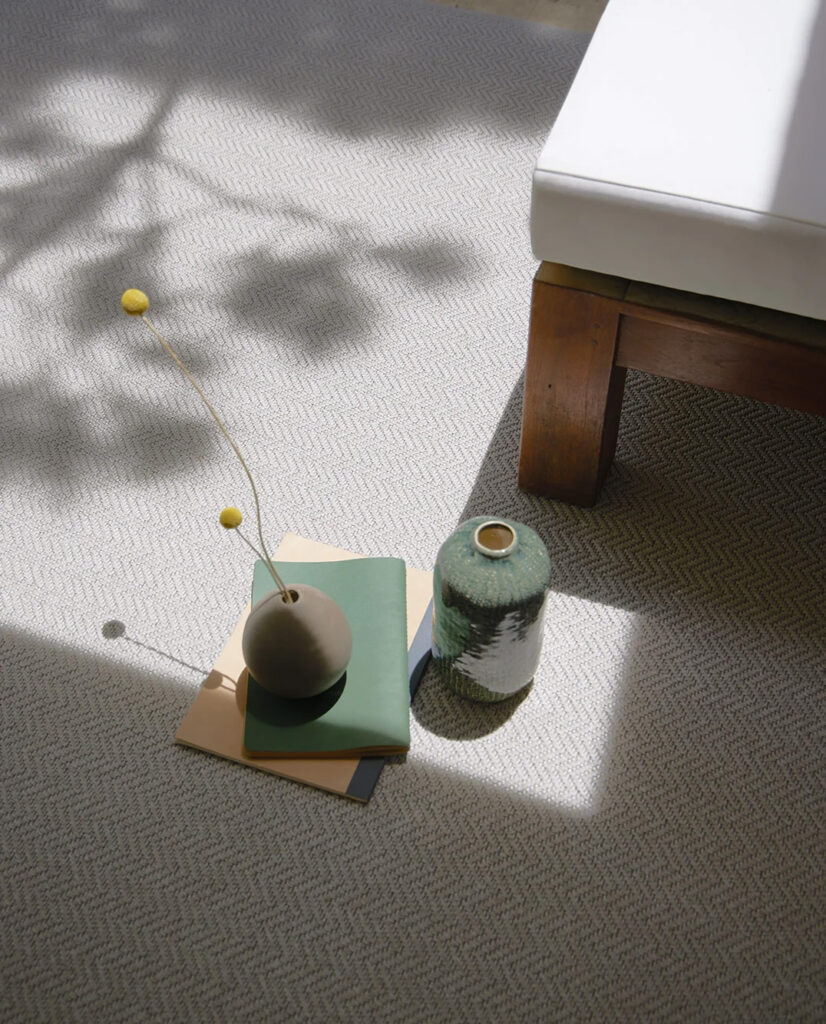
An architect selects the right flooring material for a public space by evaluating the space’s intended use, traffic volume, acoustic requirements, fire safety regulations, and visual objectives as a whole. No single factor determines the choice on its own — the right material emerges from the balance between all of them. Below, we walk through the most important questions that guide flooring material selection in public spaces.
What requirements does a public space place on flooring materials?
Public spaces place demands on flooring materials that residential spaces do not: high wear resistance, fire safety classification, easy cleanability, and often an M1 emissions classification as well. Beyond these technical requirements, the material must withstand heavy foot traffic without losing its appearance.
In Finland, flooring materials for public spaces are governed by building regulations and space-specific safety requirements. A fire safety classification is often mandatory, and a material must meet the required rating before it can even be considered for a project. The M1 emissions classification, in turn, ensures that the material does not cause indoor air quality problems.
- Wear resistance: the material must withstand continuous traffic without deteriorating quickly
- Fire safety: the space-specific fire safety classification must always be verified before selecting a material
- Emissions classification: M1-certified material does not compromise indoor air quality
- Cleanability: the surface must withstand regular mechanical cleaning
- Acoustics: particularly in office and hotel spaces, sound absorption is often a fundamental design consideration
The architect brings all of these requirements together at the very beginning of the design process, so that material selection does not run into technical obstacles later on.
How does wear resistance influence material selection?
Wear resistance is one of the most important criteria for flooring material selection in public spaces, as it directly determines the material’s lifespan and total cost. In high-traffic areas such as hotel lobbies or restaurants, a surface with poor wear resistance quickly becomes worn and unsightly, requiring premature replacement.
Wear resistance is typically assessed using the Lisson classification or an equivalent standard. The higher the foot traffic in a space, the denser the construction and the more durable the fiber required. Polyamide is one of the most durable choices among synthetic fibers for commercial use, but carpets made from wool or recycled fibers can also meet high wear requirements when the construction is right.
High-traffic spaces
In corridors, lobbies, and entrance areas, flooring is exposed to extremely heavy wear. Dense, low-pile textile carpets or carpet tiles with a textile surface are well suited to these applications, combining durability with easy maintenance. An added advantage of carpet tiles is that an individual worn tile can be replaced without having to resurface the entire floor.
Moderate-traffic spaces
In meeting rooms, hotel rooms, and office spaces, wear is significantly lower than in corridors. This opens the door to softer and visually richer materials, such as wall-to-wall carpets made from wool or wool blends, which bring warmth and acoustic comfort to a space.
When is carpet a better choice than a hard floor surface?
Carpet is a better choice than a hard floor surface when a space requires sound absorption, warmth, visual softness, or improved walking ergonomics. In offices, hotel rooms, restaurant dining areas, and meeting spaces, carpet enhances the user experience in ways that a hard surface simply cannot.
Hard floor surfaces are easier to keep clean in wet or particularly dirty environments, but they reflect sound and feel cold underfoot. Carpet absorbs sound, cushions footsteps, and creates atmosphere. Particularly in open-plan office spaces, acoustic design is often the deciding factor that leads an architect toward carpet.
- Carpet reduces footstep noise and the reflection of speech
- It improves thermal comfort, especially during the winter months
- A textile surface creates visual softness and a sense of warmth in a space
- For prolonged standing and walking, a softer surface is more ergonomic
- The range of color and surface pattern options is broader than with most hard surfaces
What is the difference between carpet tiles and wall-to-wall carpet?
A carpet tile is an individual square — typically 50 x 50 cm — that is installed piece by piece on the floor. Wall-to-wall carpet, by contrast, is installed as a continuous surface cut from a roll. The most important practical differences lie in installation, maintenance, and design flexibility.
Advantages of carpet tiles
Carpet tiles are a flexible solution for spaces where cabling runs beneath the floor, or where individual worn sections need to be replaced without resurfacing the entire floor. Tiles can also be combined in different colors and patterns, giving the designer broad visual freedom. For example, BLOQ carpet tiles offer bold colors and inventive combinations with a modular construction.
Advantages of wall-to-wall carpet
Wall-to-wall carpet creates a seamless, uniform surface that suits spaces where a clean and understated overall look is desired. It is often a more cost-effective solution than carpet tiles in large, straightforward spaces. A custom pattern or design can also be applied directly to wall-to-wall carpet using print technology.
How do environmental certifications guide flooring material selection?
Environmental certifications guide flooring material selection by setting measurable requirements for a material’s emissions, raw materials, manufacturing process, and lifecycle management. BREEAM and LEED ratings, the M1 emissions classification, and Cradle to Cradle certification are increasingly treated as starting points in public building projects — not as features added as an afterthought.
The M1 emissions classification is particularly significant in Finland, as it confirms that a material does not produce harmful indoor air emissions. Many architecture firms and developers have already established a standard practice of approving only M1-classified floor coverings for public spaces. Carpet tiles made from recycled yarn, such as Econyl, contain recycled fiber content — this is a material property that can be verified against product specifications. BREEAM and LEED rating systems may award credits for such material characteristics, depending on the specific scheme and assessment criteria.
- M1 emissions classification: ensures good indoor air quality
- BREEAM and LEED: international rating systems that account for a building’s overall environmental impact
- Cradle to Cradle: a certification that covers specific aspects of a material’s recyclability and manufacturing practices, as defined by the scheme
- Recycled raw materials: carpet tiles made from Econyl yarn contain recycled fiber — verify the specific recycled content with the manufacturer’s product documentation
Several products across our collections hold M1 certification, and we supply materials with certifications applicable to BREEAM and LEED ratings as well. Browse our references to see how environmental requirements have been addressed across a range of projects.
Can a custom design or corporate identity be printed onto a carpet?
Yes, a custom design or corporate identity can be printed directly onto a carpet. Modern print technology makes it possible to reproduce virtually any pattern, logo, or color palette directly onto the carpet surface — with results that hold up to the demands of heavy commercial use.
A printed carpet is an effective way to reinforce brand identity in spaces where visual appearance is part of the customer experience. In hotel lobbies, restaurants, and corporate reception areas, a custom floor surface stands out and leaves a lasting impression. A designer or architect can submit their own artwork, from which a carpet surface capable of withstanding heavy wear will be produced.
Print technology is suitable for both wall-to-wall carpets and individual area rugs. The production process takes the space’s traffic volume into account, and an appropriate backing construction is selected to ensure the visual appearance remains sharp over time.
Nothing replaces a real material sample in the design process. Order a material sample to see the true color and feel the surface for yourself before making your final decision. Would you like to discuss the details of your project? Contact our specialists and we will work together to find the right solution for your space.