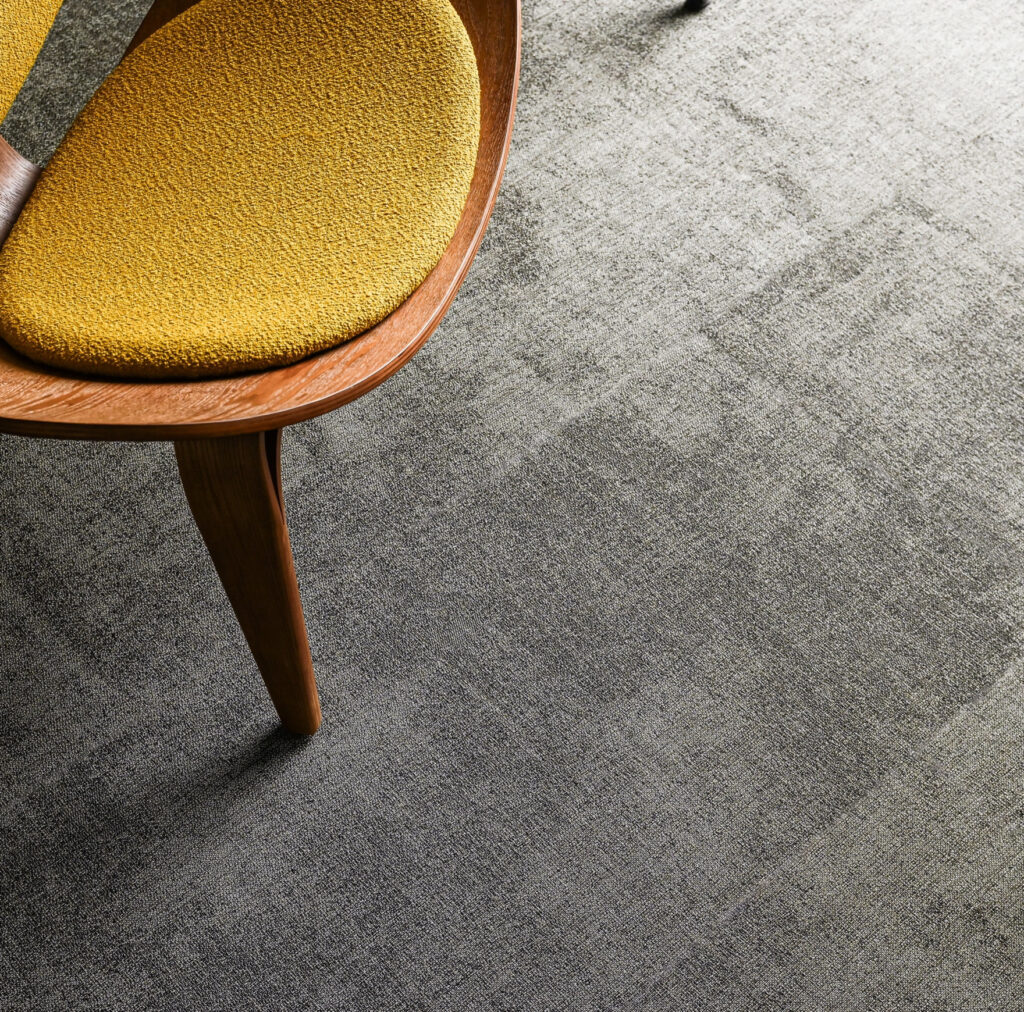
High-quality carpets deliver on the promise of a premium commercial space in a tangible way: they communicate attention to detail, reinforce brand identity, and make a space more comfortable and functional. The right flooring solution combines durability, acoustics, and visual appeal in a way that is both seen and felt every day. Below, we address the most common questions businesses consider when choosing carpets for their commercial spaces.
What does your flooring say about your brand?
Flooring is one of the first things a visitor notices when they walk into a space. A high-quality textile carpet or carpet tile signals that a company cares about the details and the customer experience. A poorly chosen or worn floor, on the other hand, undermines the overall impression of an otherwise well-appointed space.
The floor of an office, restaurant, or hotel is part of the visual language of a brand, just like a logo or interior design. Color, texture, and material work together with the space to communicate what kind of company you are. A neutral, understated floor suits a professional services firm, while a bolder pattern or custom design can become part of what sets a brand apart.
Companies looking to reinforce their brand identity at every touchpoint can also use carpets as a communication tool. A custom flooring solution that echoes the company’s colors or design language creates a cohesive, unified space. This goes beyond aesthetics — it is a way to build trust and project a professional image.
How do textile carpets improve office acoustics and comfort?
Textile carpets significantly reduce noise compared to hard floor surfaces. Textile fibers absorb footstep sounds and reduce echo, making open-plan offices and meeting rooms quieter and easier to work in. Better acoustics directly improve concentration and communication.
From a comfort standpoint, textile carpets bring warmth and softness to a space that hard surfaces simply cannot offer. This is especially important in areas where people spend long periods of time, such as offices and waiting rooms. A soft surface also reduces foot fatigue for those who work standing up or move around frequently.
Acoustics as a challenge in open-plan offices
Open-plan offices tend to accumulate noise easily, and textile carpet is one of the most effective ways to manage this. Ntgrate textile vinyls, for example, offer a sound reduction of at least 19 dB — a significant improvement over hard flooring surfaces. This makes them a highly practical choice, particularly for corridors and lobby areas.
How material affects underfoot comfort
The choice of material affects both acoustics and feel. Wool is naturally excellent at absorbing sound and brings warm tones to a space. Polyamide, on the other hand, is a durable and low-maintenance choice for high-traffic areas. Both are well suited to office use, and the right choice depends on how the space is used and how much wear it needs to withstand.
What is the difference between carpet tiles and broadloom carpet in commercial spaces?
Carpet tiles are individual pieces — typically 50 × 50 cm — that are installed in sections across the floor. Broadloom carpet comes on a roll and covers the entire floor as a continuous surface. Both are suitable for commercial spaces, but they differ in their ideal applications and maintenance characteristics.
Carpet tiles: flexibility and easy maintenance
Carpet tiles are a practical choice for spaces where the floor wears unevenly or where the ability to replace individual sections is important. If a single tile becomes damaged or worn, it can be swapped out without replacing the entire floor — making carpet tiles a cost-effective solution for heavy use. The modular format also allows for creative patterns and color combinations that are not achievable with broadloom carpet. BLOQ carpet tiles are a great example: they combine bold colors and modular design freedom.
Broadloom carpet: a seamless look and soft feel
Broadloom carpet creates a seamless, continuous surface that is particularly well suited to hotels, meeting rooms, and formal reception areas. It typically offers a softer feel underfoot and presents a clean, elegant aesthetic when a simple and refined result is the goal. Broadloom carpets are delivered on rolls and cut to the exact dimensions of the space.
Can a carpet be printed with a custom company design?
Yes, carpets can be printed with a fully custom company design. We use the latest print technology to supply printed carpets for commercial spaces including offices, restaurants, and hotels. A designer can submit their own artwork, which is then reproduced on a carpet material built to withstand heavy use.
This is especially valuable for companies that want to bring their brand colors, logo, or design language to the floor itself. A custom carpet makes a space instantly recognizable and visually cohesive. The result is high quality, and normal wear does not affect the longevity of the print, as the printing technology has been developed specifically to meet the demands of commercial environments.
Printed carpets can be produced as both broadloom and area rugs. If you want to see and feel the material before making a decision, order a material sample directly from us. Nothing replaces a real sample that you can see in the right light and feel with your own hands.
How do you choose a durable carpet for high-traffic areas?
For high-traffic areas, it is worth choosing a carpet whose fiber, backing, and surface texture are designed to withstand heavy footfall. The key factors are fiber material, wear rating, fire safety, and ease of maintenance. With these in mind, there is a solution for virtually any commercial space.
Why material matters for durability
Polyamide is one of the most common and durable materials for commercial use. It withstands heavy wear, is easy to clean, and retains its appearance over time. Wool is a natural alternative that also holds up well, though it requires slightly more attention when it comes to cleaning. Textile vinyls are particularly well suited to spaces where the floor is exposed to moisture or exceptionally heavy use.
Certifications as indicators of quality
The M1 emission classification for building materials is an important indicator for indoor air quality. It confirms that a product does not release harmful compounds into the indoor environment — which is especially important in spaces where people spend extended periods of time. Many of the products we supply carry the M1 certification, and this is one of the criteria we recommend factoring into your selection process.
Environmental certifications such as BREEAM and LEED may also be relevant for companies with sustainability commitments. When evaluating products in relation to these certification schemes, we recommend verifying which specific criteria a given carpet product meets and to what extent.
Who handles carpet installation and project coordination?
We manage carpet installation and project coordination from start to finish. Our in-house installation service covers projects of all sizes, and our strong network of skilled professionals handles even the most demanding installations across Finland, on schedule.
Every stage of the project is covered: from design and material selection through cutting, binding, and installation. Our in-house binding workshop — staffed by skilled seamstresses — and our computer-controlled cutting machines ensure a precise, finished result. The client has a single point of contact who coordinates the entire supply chain.
We also provide technical support and training, both in person and via video call, so collaboration runs smoothly regardless of where in Finland the project is taking place. Working with a small, focused organization means communication is straightforward and things move quickly.
If you have a commercial fit-out project underway or in the planning stages, get in touch and we will tell you more about how we can help. You are also welcome to browse our references and see the kinds of projects we have completed for offices, hotels, and other commercial spaces.