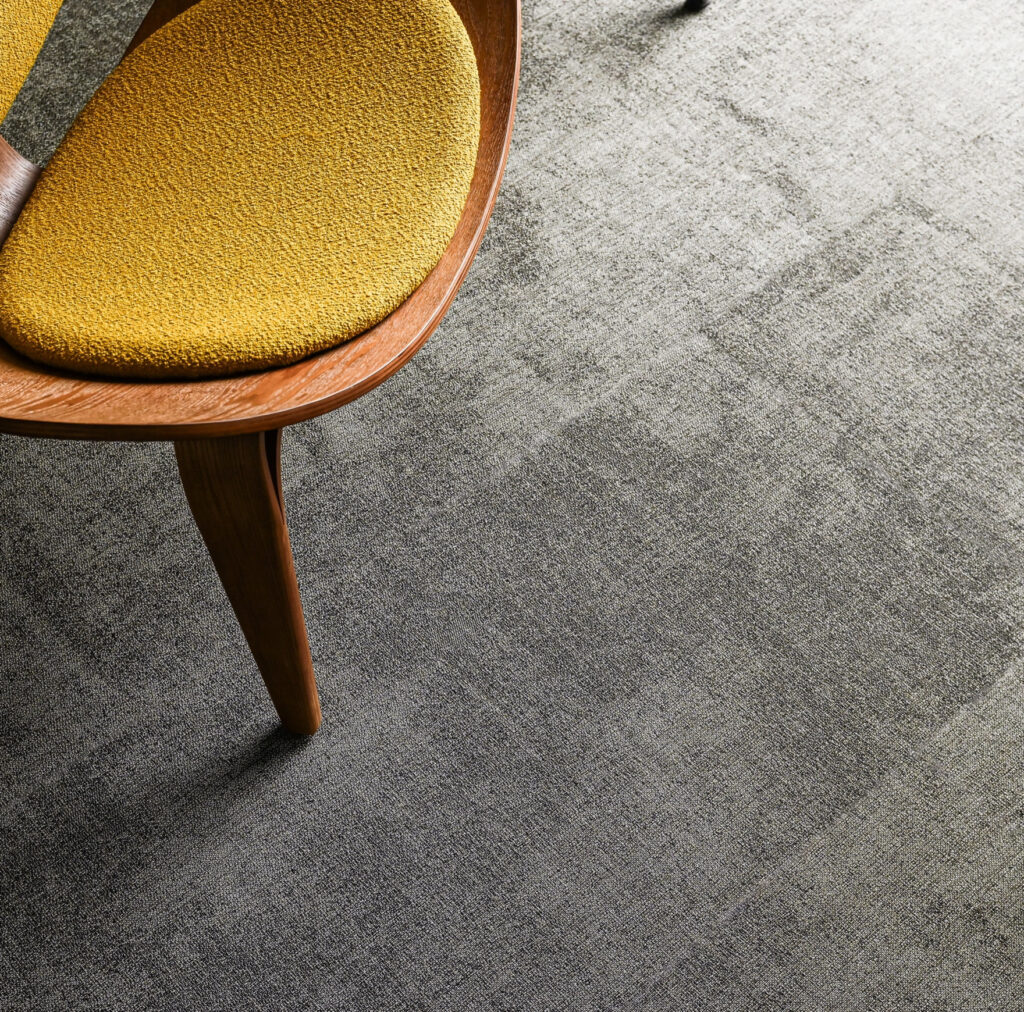
An inviting workspace starts with the right flooring. The right flooring solution brings warmth to a space, improves acoustics, and supports a company’s visual identity — all while withstanding the demands of daily heavy use. Below, we address the most common questions that arise when planning flooring for a commercial space.
What flooring materials are recommended for commercial spaces?
Textile carpets, carpet tiles, and textile vinyls are the best choices for commercial spaces, as they combine durability, acoustic performance, and aesthetics. Materials must withstand heavy use, meet fire safety standards, and be easy to maintain. The most popular fibers are polyamide, wool, and sisal, along with options made from recycled materials.
Textile carpets and wall-to-wall carpets
Wall-to-wall carpets and area rugs are most often produced from four-meter-wide rolls, resulting in few or no seams. Common materials include wool, sisal, polyamide, and recycled yarn such as PET fiber. These are widely used in offices, hotels, and restaurants, as they offer both comfort and a long service life.
Carpet tiles
Carpet tiles are a flexible option, particularly for spaces where the flooring needs to be replaced section by section or where cable channels require maintenance access. They are available with various installation methods, such as releasable adhesive or self-adhesive LiftBAC backing. High-quality carpet tiles are offered by brands such as BLOQ and Modulyss, whose collections combine durability with versatile design.
Textile vinyls
Textile vinyls are particularly well suited to spaces that require the ambiance of a textile surface combined with the practicality of a vinyl finish. They are moisture-resistant and easy to maintain, making them an excellent choice for corridors, lobbies, and even wet areas.
How does flooring affect the atmosphere and acoustics of a workspace?
Flooring is one of the largest surfaces in any space, and it has a direct impact on both the visual atmosphere and the acoustic environment. A textile surface significantly reduces noise from footsteps and conversation compared to a hard floor. A soft, warm floor makes a space more welcoming and reduces distracting background noise.
From an acoustic standpoint, textile carpet in an office is one of the most effective ways to improve working conditions in open-plan offices and meeting rooms. For example, Ntgrate’s textile vinyls provide a minimum sound reduction of 19 dB, and up to 22 dB on special order. This is a significant difference in spaces where noise disruptions affect productivity.
In terms of atmosphere, the color and texture of the flooring shape the character of the space. Dark, rich tones add a sense of prestige and warmth, while light and neutral shades open the space up. Surface texture also matters: a soft tufted finish feels luxurious, while a denser woven surface conveys clarity and professionalism.
How do you choose flooring that reflects your company’s brand?
A company’s brand identity extends all the way to its flooring choices. The color, pattern, and material of the floor can either reinforce brand identity or work against it. The best starting point is the company’s color palette and visual style, from which a flooring choice can be made that strengthens the desired impression.
- Color: Brand colors can be incorporated directly into the flooring or used as accents alongside a neutral base.
- Pattern: Geometric patterns suit a modern, technical corporate look, while organic shapes and natural materials communicate warmth and a connection to nature.
- Material: Wool and sisal convey quality and durability, while polyamide suggests practicality and longevity.
- Printed carpet: A company’s own logo or pattern can be printed directly onto the carpet, turning the floor into part of the brand communication.
At VMC Project, we also design and supply printed carpets featuring the designer’s own artwork. This makes it possible to achieve a fully customized result that fits the company’s visual identity perfectly.
What is the difference between carpet tiles and wall-to-wall carpet?
Carpet tiles are individual pieces, typically 50 x 50 cm, installed one at a time. Wall-to-wall carpet, on the other hand, is installed as a continuous surface cut from a roll. Both have their own strengths, and the choice depends on the intended use of the space and practical requirements.
Carpet tiles: flexibility and maintainability
- Individual worn or damaged tiles can be replaced without replacing the entire floor.
- Ideal for spaces with underfloor cabling or other technical infrastructure.
- Allow for more creative patterning by combining different colors and orientations.
- Easy to transport and store.
Wall-to-wall carpet: uniformity and softness
- Provides a seamless, uniform surface that looks clean and is easy to keep tidy.
- Generally softer and more comfortable to walk on.
- Particularly well suited to hotel rooms, meeting rooms, and reception lobbies.
- Printed patterns work exceptionally well on roll goods.
Are there flooring options with specific environmental properties for commercial spaces?
Several flooring options in our range have documented environmental properties, with consideration given to both the origin of materials and aspects of the production process. Many products carry the M1 emission classification for building materials, which sets strict limits on indoor air emissions. A number of products also incorporate recycled materials or natural fibers.
Concrete examples of products with documented properties:
- Recycled content in backing: According to the manufacturer, Infloor’s carpet tiles have a backing that contains 70% recycled material. The manufacturer states that the tiles are designed to be returned for recycling through Infloor’s own take-back scheme. Infloor has also received recognition from the German Ministry of the Environment for its environmental achievements.
- Natural fibers: Wool and sisal are renewable natural materials. At the end of their service life, they biodegrade under appropriate conditions.
- Low-emission products: M1 certification means that a product meets strict indoor air emission limits, which is important for the well-being of staff.
- Renewable energy in production: According to the manufacturer, Finnish manufacturer VM Carpet uses electricity generated from renewable energy sources in its production process.
When choosing flooring, taking documented material and emission properties into account can be one factor in supporting a building’s BREEAM or LEED assessment.
How does a commercial flooring renovation progress from planning to installation?
A commercial flooring renovation typically moves from a needs assessment through material selection and measurement to final installation. The process is manageable when guided by an expert who understands both the materials and the installation requirements. We handle every phase of the project under one roof.
Planning and material selection
The project begins with an assessment of the space’s intended use, traffic levels, and visual objectives. At this stage, the appropriate material, color, and texture are selected. Material samples are an essential part of this phase, as color and feel can look and feel very different on screen compared to an actual space.
Nothing replaces a real material sample. You can see the true color and feel the material in your hands before making a decision. Order a material sample from us, and we will send your chosen sample directly to you to see and touch.
Measurement, cutting, and binding
Once the material has been selected, the space is measured precisely. Our in-house binding workshop, with its skilled seamstresses and computer-controlled cutting machines, finishes the carpets to exactly the right shape and size. This step is crucial to achieving a clean, polished final result.
Installation and project completion
Installation is carried out by our own installation service or through our extensive network of professionals across Finland. Even the most demanding installations are completed on schedule. At every stage of the project, a skilled professional is on hand to ensure the final result meets expectations.
Would you like to see the kinds of commercial projects we have completed? Browse our references and draw inspiration from our successful installations. If you already have a project in mind, contact us and we will work together to design the perfect flooring solution for your space.