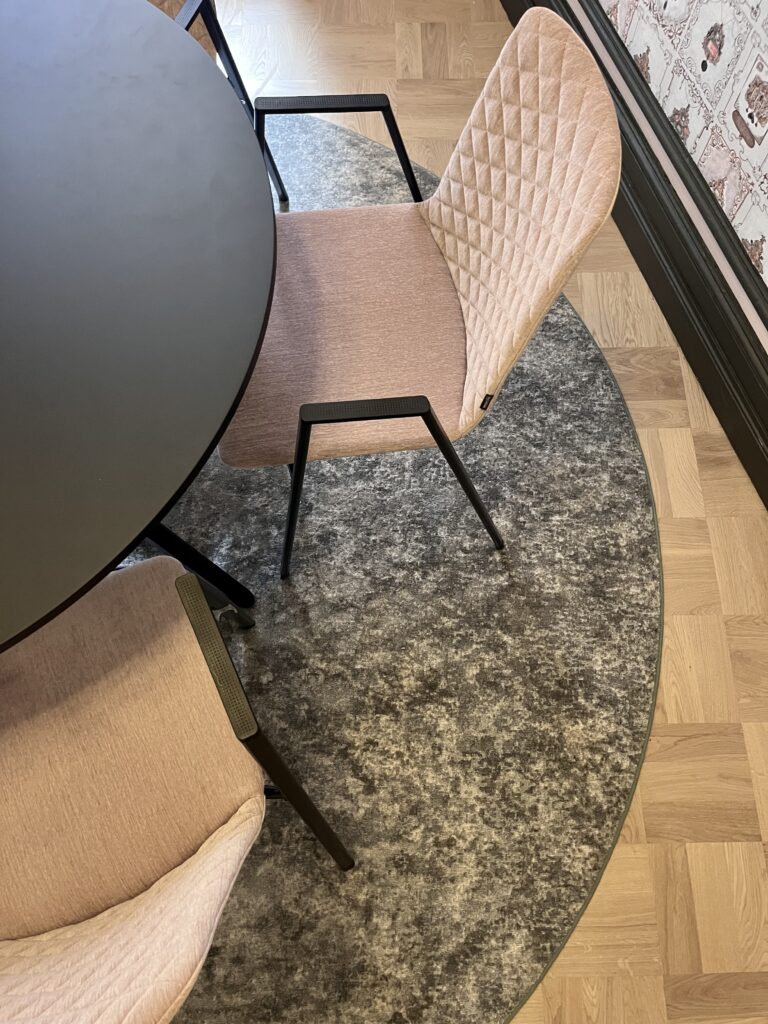
An open office space may feel modern and collaborative, but it brings with it one significant challenge: noise. When phone calls, conversations, keyboard typing, and foot traffic blend together, they create a disruptive sound environment that directly affects work quality and employee well-being. Explore our services and find solutions to your office acoustics problems.
Fortunately, the solution is simpler than you might think. Textile carpets offer an effective and visually appealing way to significantly improve office acoustics. They not only dampen sounds but also create a more comfortable and professional work environment.
Why does office noise hinder work productivity?
Office noise isn’t just a minor distraction – it concretely affects employee performance and well-being. Constant background noise forces the brain to process excess information, which consumes energy and weakens concentration ability.
Noise is particularly harmful for tasks requiring deep thinking or precision. When an employee tries to focus on a complex problem, a phone call from a neighboring desk or sound from the copy machine interrupts the thought process. This results in the same task taking significantly more time and energy.
A noisy work environment also increases stress and fatigue. Employees unconsciously tense their muscles and raise their voices to be heard better. By day’s end, this manifests as tiredness and irritability, which affects both the work atmosphere and home life.
Acoustic discomfort also impacts the customer experience. When a client arrives at an office that echoes and is noisy, it doesn’t create a professional impression. Private conversations can be heard throughout the space, which may raise questions about confidentiality.
How do textile carpets reduce office noise?
Textile carpets function as natural sound dampeners by absorbing sound instead of reflecting it back into the space. Hard floors, such as laminate or stone, act as sound-reflecting surfaces that amplify and prolong sound reverberation. Textile, on the other hand, stops sound waves and converts them into thermal energy.
Textile carpets are particularly effective against footstep noise. High heels on hard flooring can create sound levels of 20–30 decibels that can be heard throughout the office. Carpet dampens footstep sounds to nearly nothing, making the space immediately more peaceful.
The fiber structure of textile carpet creates many small air pockets that slow the movement of sound waves. The thicker and denser the carpet, the more effectively it dampens sounds. This particularly affects mid-frequencies, where human voice carries best.
The carpet surface texture also affects acoustic properties. A pile surface is more effective at sound dampening than a smooth surface because it creates more surface area for sound wave-absorbing material. Domestic textile carpets often utilize traditional weaving techniques that create an optimal structure for acoustics.
Choosing the right acoustic carpet for the office
When selecting acoustic carpet for an office, the most important factor is the material’s density and thickness. Wool carpets offer excellent sound dampening thanks to their natural fibers. Wool is also a durable material that works well in high-traffic spaces. Synthetic fiber carpets can offer practical advantages in terms of maintenance and may be suitable for users sensitive to certain natural materials.
Color palette significantly affects the space’s atmosphere and interior design. Dark shades hide dirt better but can make a space feel gloomy. Light colors open up space but require more frequent cleaning. Current trends favor natural earth tones and subdued color palettes that suit many interior styles.
Patterns offer an opportunity to bring personality to the office. Geometric patterns are timeless and suit modern offices, while organic forms create a warmer atmosphere. Explore our carpet collection and find the perfect option for your office style.
Practical considerations shouldn’t be forgotten. The carpet must withstand heavy use, be easy to clean, and meet fire safety requirements. M1 emission classification ensures that the carpet doesn’t compromise indoor air quality. Areas under wheeled chairs require particularly durable material or protective plastic.
The importance of installation in acoustics
Professional installation significantly affects the carpet’s acoustic properties. The substrate must be level and dry so the carpet sits tightly against the floor. Air gaps must not remain, as they can cause echoing.
Carpet tiles offer a practical alternative when the office needs frequent modifications. Replacing individual tiles is easy, and they enable flexible space planning. Wall-to-wall carpet, on the other hand, creates a unified and calm impression.
Contact an acoustics specialist
Improving office acoustics isn’t just a comfort issue – it’s an investment in staff well-being and productivity. A properly selected textile carpet can transform a noisy space into a peaceful work environment where concentration and collaboration flow naturally.
Every office is different, and solving acoustic problems requires expertise. The space’s size, shape, purpose, and current interior design all affect what type of carpet selection works best. A professional can provide a customized solution that considers both acoustic and aesthetic needs.
At VMC Project, we understand that every project is unique. We help you find the best solution for your office’s acoustic problems and offer comprehensive service from planning to installation. Order a material sample or contact us, and let’s discuss together how we can improve your work environment.